Product Design & Manufacturing Dossier
HO'OMALU
Design Pack
The Musical Entertainment Seat is the flagship Ho'omalu product: a child sits on it and plays it directly. Five of the eight front buttons are each wired to one specific instrument inside, drums, guitar, xylophone, the Ferris-wheel bell chime, saxophone, press it and that instrument lights up and plays. The remaining three trigger bonus sound and light effects. No app required to use it. Version two, the Photo-Frame Music Box, is a companion keepsake for the nursery and has its own section later in this document.
Button-operated. Battery powered. Portable.
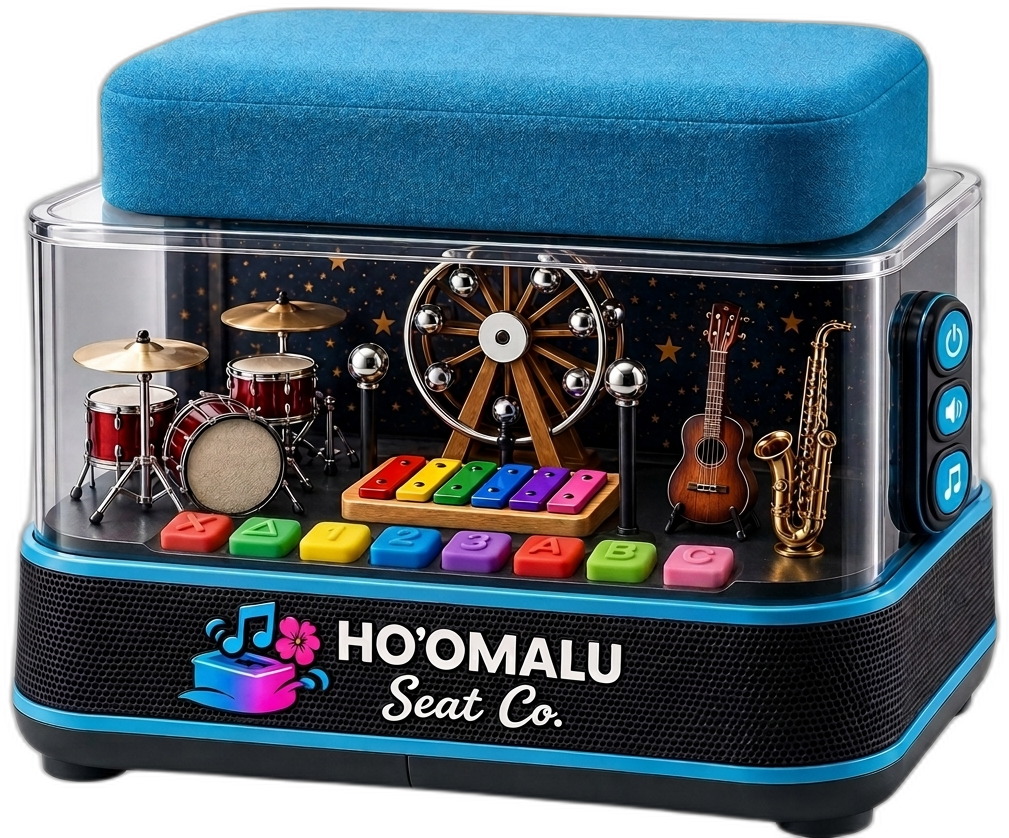
A row of eight chunky press-buttons runs across the front, each cap textured and molded with a learning symbol (X, triangle, 1-2-3, A-B-C) a toddler can feel and see. Five are wired one-to-one to an instrument inside the case, not a shared effect. Press the drum-kit button, the drums light up and play. Press the Ferris-wheel button, it spins into light and chimes. Same for the xylophone, the guitar, the saxophone. The remaining three buttons trigger bonus sound and light effects, extra play value without adding more instruments to the case. Three more buttons on the side handle power, volume, and song selection. No pairing, no setup, no phone required to use the seat.
Bluetooth is a separate, optional feature for a parent, not the way the toy is operated. It simply turns the unit into a standard Bluetooth speaker, mom or dad pairs their own phone and plays whatever music they want through it, no custom app, no melody library to build or maintain. Keeping this secondary, instead of the primary control method, is a deliberate cost and reliability decision: it means the core toy works the moment it's powered on, and the electronics inside can be built two ways depending on budget (see Section 06).
Five of the eight front buttons each trigger one instrument's light and sound directly, drums, guitar, xylophone, the Ferris-wheel chime, saxophone, the rest trigger bonus effects.
Power, volume, and song-skip live on three side buttons, simple physical controls a toddler can also use.
Pair a phone and stream your own music through the built-in speaker, standard Bluetooth audio, nothing custom. Not required to play.
Every choice below was weighed against another way to build it. This is the short version of what we landed on, and why.
| Physical button interface, primary | The core toy works instantly with no pairing and no phone, the single biggest reliability and cost win in this product. |
| Five buttons, five instruments | Five of the eight front buttons each wire to a single instrument's own light and sound circuit, drum kit, guitar, xylophone, Ferris-wheel chime, saxophone, each distinct and recognizable, not one shared, generic light show. The other three trigger bonus effects. |
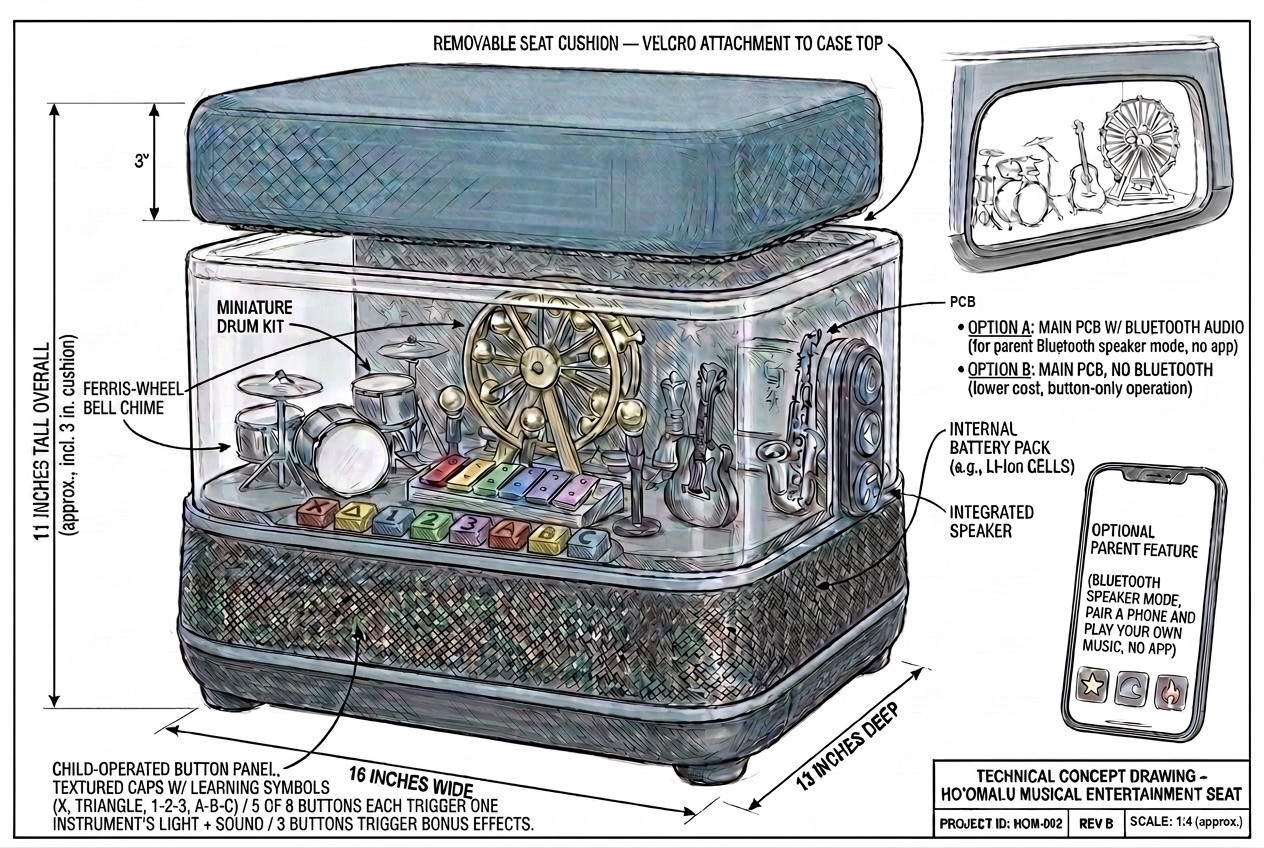
| Removable flat seat cushion | A simple 3" cushion attached with a Velcro strip, no backrest, no harness, no armrests. Keeps tooling and BOM cost down versus a molded bucket seat. |
| Bluetooth as a standard speaker, not a custom app | No app to design, build, or maintain. Standard Bluetooth audio streaming lets a parent play their own music. Lets us offer a lower-cost, no-Bluetooth board as a second SKU tier (Section 06). |
| Wraparound clear window | The plexiglass window continues onto the side panel so the instrument scene is visible from more than one angle, not just head-on. |
The exploded view below is the working reference for tooling and assembly, the callouts correspond to the parts list and the Bill of Materials in Section 05.
This section answers the two questions every factory rep asks before quoting a number: what does this actually cost to build, and what could go wrong.
The main housing is an injection-molded two-piece shell, upper and lower, that the wraparound plexiglass window seats into before final assembly. The instrument miniatures are molded or 3D-printed separately and set into the housing before the window goes in, each one wired to its corresponding front-panel button.
Electronics, speaker, battery, and the main control board, mount to a single internal bracket so the whole electronics package can be built and tested as one sub-unit before it's sealed inside the housing. A bad unit gets caught and swapped before assembly, not after.
Custom tooling is limited to the two shell halves and the button caps. Everything else, speaker module, battery pack, control board, is off-the-shelf. That keeps unit cost predictable and the tooling investment to a short list, not a dozen custom parts.
| Upper/lower shell | Injection-molded ABS/PC blend, color TBD — custom tooled |
| Wraparound window | Clear acrylic/polycarbonate, custom cut — off-the-shelf material |
| Instrument miniatures | Molded or 3D-printed set (drum kit, Ferris-wheel chime, xylophone, guitar, saxophone) — glued/pinned in place |
| Front button panel | 8x silicone/rubber press-buttons over a membrane switch array — custom tooled caps with tactile textures and learning symbols (X, triangle, numbers, letters), off-the-shelf switch film |
| Side control buttons | 3x silicone/rubber buttons (power/volume/song) — off-the-shelf |
| Speaker grille | Perforated mesh vent, molded into lower shell |
| Seat cushion | High-density foam, removable fabric cover, Velcro strip attach — off-the-shelf |
| Speaker | Integrated speaker module — off-the-shelf |
| Battery | Rechargeable lithium pack, certified cell — off-the-shelf |
| Control board | Two options, see Section 06 — off-the-shelf hardware, custom firmware |
| Charging port | USB-C — off-the-shelf |
| Rubber feet | 4x non-slip rounded feet — off-the-shelf |
| Branding | Molded or printed directly onto the housing, no separate badge or plate |
Because the buttons run the toy on their own, the control board can be built two ways depending on target price point. Both should be quoted.
Adds standard Bluetooth speaker mode: a parent pairs their own phone and streams their own music, no custom app. Higher BOM cost, positions the product at a premium price point.
Button-only operation, same lights and sounds per instrument. Lower cost, simpler compliance testing.
| Battery | 3.7V lithium-polymer, ~2,000mAh rechargeable cell (~7.4Wh) |
| Charge time | ~2 hours to full, via USB-C |
| Runtime | 6–8 hours of typical intermittent play per charge (short button-triggered bursts, not continuous full-power playback) |
| Wireless (Option A only) | Bluetooth 5.0, A2DP audio streaming profile, ~30 ft / 10m range |
| Audio output | 3W embedded driver |
Approximate target footprint, factory to confirm final tolerances.
| Footprint | 16"W x 13"D |
| Height | ~11" including the 3" seat cushion |
| Weight | ~5–6 lbs, empty (rough estimate, shell wall thickness plus the wraparound acrylic window and electronics) |
Three stages. This document is stage one.
This document, the design direction a factory can quote against. Complete now.
When you're ready, factory sourcing and a working prototype are scoped and quoted together, through Ameri Asia Works' overseas manufacturing partners.
Final run, locked pricing, ready to ship.
| Shell | Two-tone ABS/PC, glossy finish, color TBD |
| Window | Clear acrylic/polycarbonate, wraparound |
| Cushion | High-density foam, removable, Velcro attach |
| Power | Rechargeable lithium battery, USB-C charging |
| Control | Buttons primary, Bluetooth speaker optional (2 board tiers) |
| Footprint | ~16"W x 13"D |
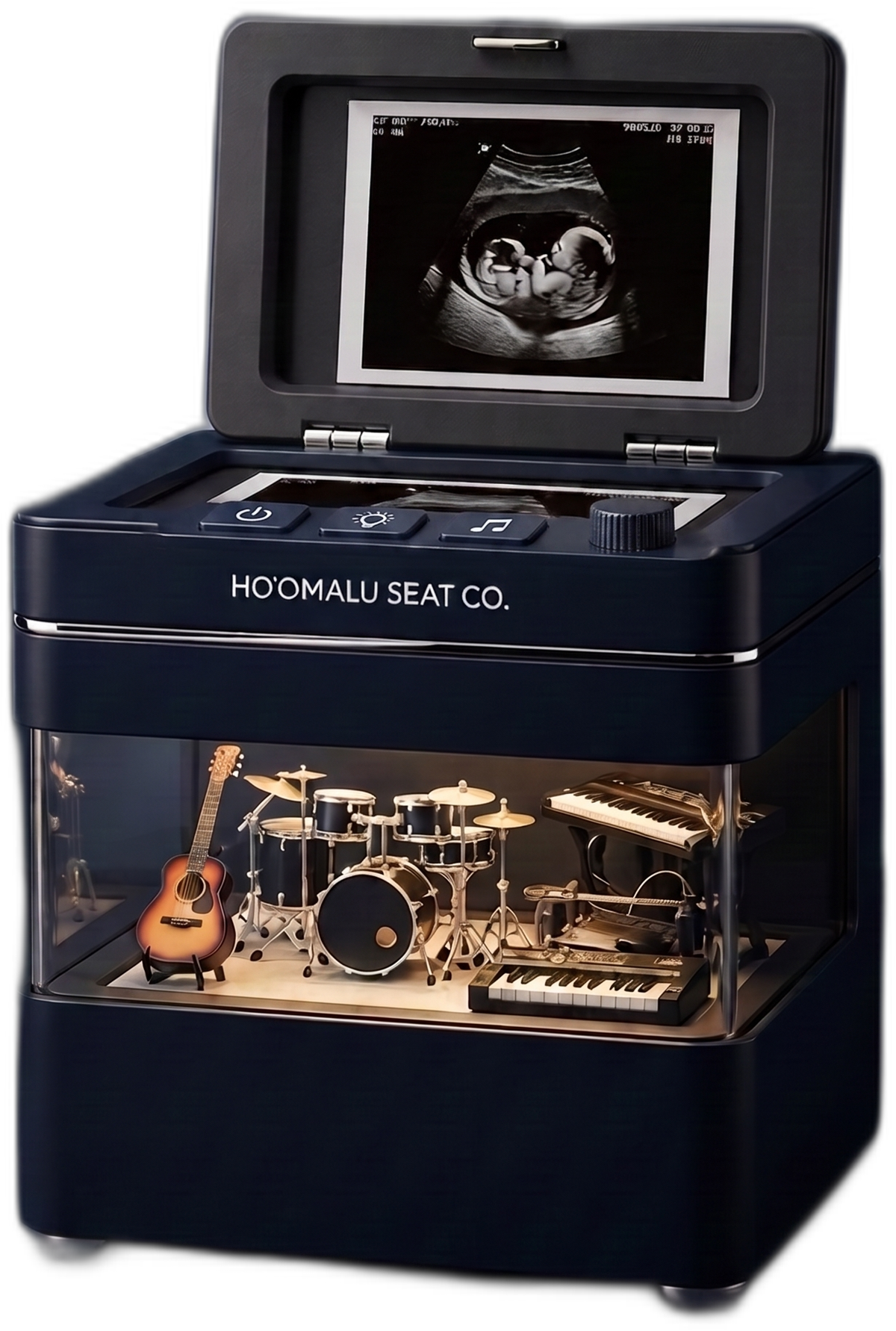
No seat, no child-operated buttons. A hinged lid holds a printed sonogram photo behind a shatterproof acrylic cover, a simple, understated hinge, no ornate hardware.
Beneath the lid, a flat shatterproof acrylic mirror panel covers the electronics compartment, so opening the case never exposes raw components, just a mirror. The lit instrument window concept carries over from the Musical Entertainment Seat, here with a drum kit, guitar, and a small piano and keyboard, kept understated rather than bright, this is a bedside or shelf piece, not a plaything.
A parent runs it with three physical buttons and a volume dial on the top edge of the base: power, light, and music. The light button runs the soft glow inside the window on its own, so the same unit works as a bedside nightlight whether or not anything's playing. That's a real second function, not a side effect, for a product meant to sit on a nightstand. Bluetooth is optional, for streaming a phone through the speaker, never required to use it.
Parent controls three buttons on the top edge (power, light, music) plus a volume dial. Power button on/off. Light button cycles through soft colors (blue, white, red) with fade and twinkle effects; press and hold to step brightness. Music button scrolls through prerecorded lullabies. Optional Bluetooth pairs a phone for streaming audio, or the unit operates standalone with preloaded content.
Press to scroll through prerecorded lullabies and sleepy music. Optional Bluetooth streams from a phone, or unit plays standalone content without connection.
Cycles through soft LED colors (blue, white, red) with adjustable effects (fade, twinkle). Press and hold to step brightness. Works independent of music for true nightlight mode.
No glass anywhere. The lid photo cover and the interior panel are both shatterproof acrylic. Buttons positioned on top edge, out of reach from crib/bed.
The exploded view below is the working reference for tooling and assembly, the callouts correspond to the parts list and the Bill of Materials in Section 04.
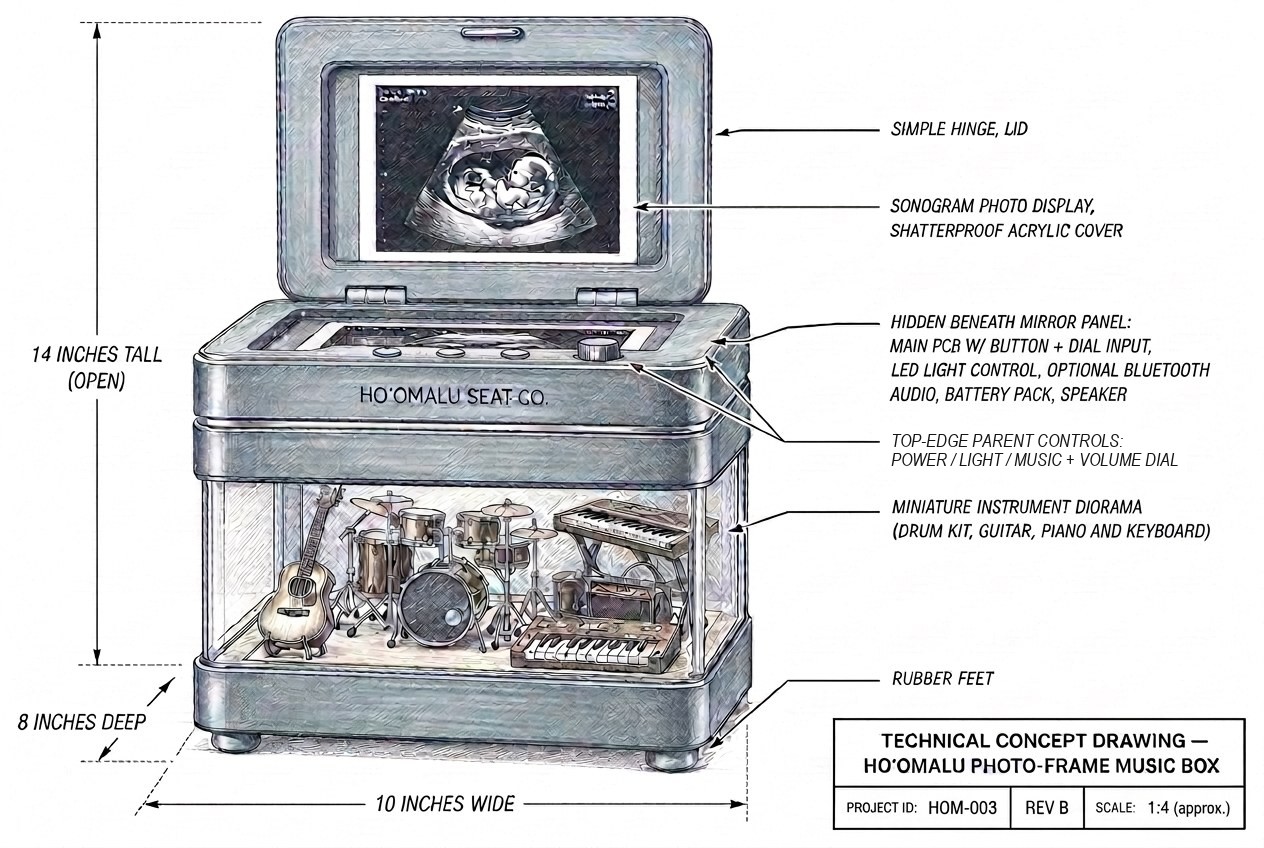
Custom tooling is limited to the case shell and the hinged lid. The mirror panel and acrylic photo cover are cut to size from off-the-shelf shatterproof acrylic stock, no custom mold needed there. Electronics, PCB, battery, speaker, mount to a single bracket hidden beneath the mirror panel and are tested as one sub-unit before final assembly.
| Upper/lower shell | Injection-molded ABS/PC blend, navy — custom tooled |
| Hinged lid | Injection-molded shell + simple metal hinge — custom tooled |
| Photo cover | Shatterproof acrylic, custom cut — off-the-shelf material |
| Mirror panel | Shatterproof acrylic mirror, custom cut — off-the-shelf material |
| Instrument diorama | Molded or 3D-printed set (drum kit, guitar, piano and keyboard) — glued/pinned in place |
| Window | Clear acrylic/polycarbonate — off-the-shelf material |
| Speaker | Integrated speaker module — off-the-shelf |
| Battery | Rechargeable lithium pack, certified cell — off-the-shelf |
| Top-edge controls | 3x tactile silicone buttons (power / light / music) + rotary volume potentiometer w/ knob — off-the-shelf |
| Control board | MCU w/ button and dial inputs, PWM channel for LED color and dimming; optional Bluetooth (A2DP) audio — off-the-shelf hardware, custom firmware |
| Charging port | USB-C — off-the-shelf |
| Rubber feet | 4x non-slip rounded feet — off-the-shelf |
| Branding | Molded or printed directly onto the lid band, no separate badge or plate |
| Battery | 3.7V lithium-polymer, ~2,500mAh rechargeable cell (~9.25Wh), larger than V1's cell since the nightlight can run unattended overnight |
| Charge time | ~2.5 hours to full, via USB-C |
| Runtime, light only | ~10–12 hours on a low-draw LED nightlight mode, enough for a full night |
| Runtime, audio playing | ~2.5–3 hours of continuous audio playback at full volume |
| Wireless (optional) | Bluetooth 5.0, A2DP audio streaming profile, ~30 ft / 10m range |
| Audio output | 3W embedded driver |
Approximate target footprint, factory to confirm final tolerances. Optimized for bedside nightlight and sonogram display.
| Footprint | 10"W x 8"D (compact nightlight profile, sonogram-sized) |
| Height | ~14" with the lid open |
| Weight | ~2–3 lbs, empty (rough estimate, reduced footprint with lighter case) |
| Shell | Navy ABS/PC, glossy finish |
| Lid cover / mirror | Shatterproof acrylic, rounded edges, no glass |
| Power | Rechargeable lithium battery, USB-C charging |
| Control | Three parent-control buttons (power, light, music) plus volume dial; Bluetooth optional |
| Footprint | ~10"W x 8"D x 14"H (with lid open) |